


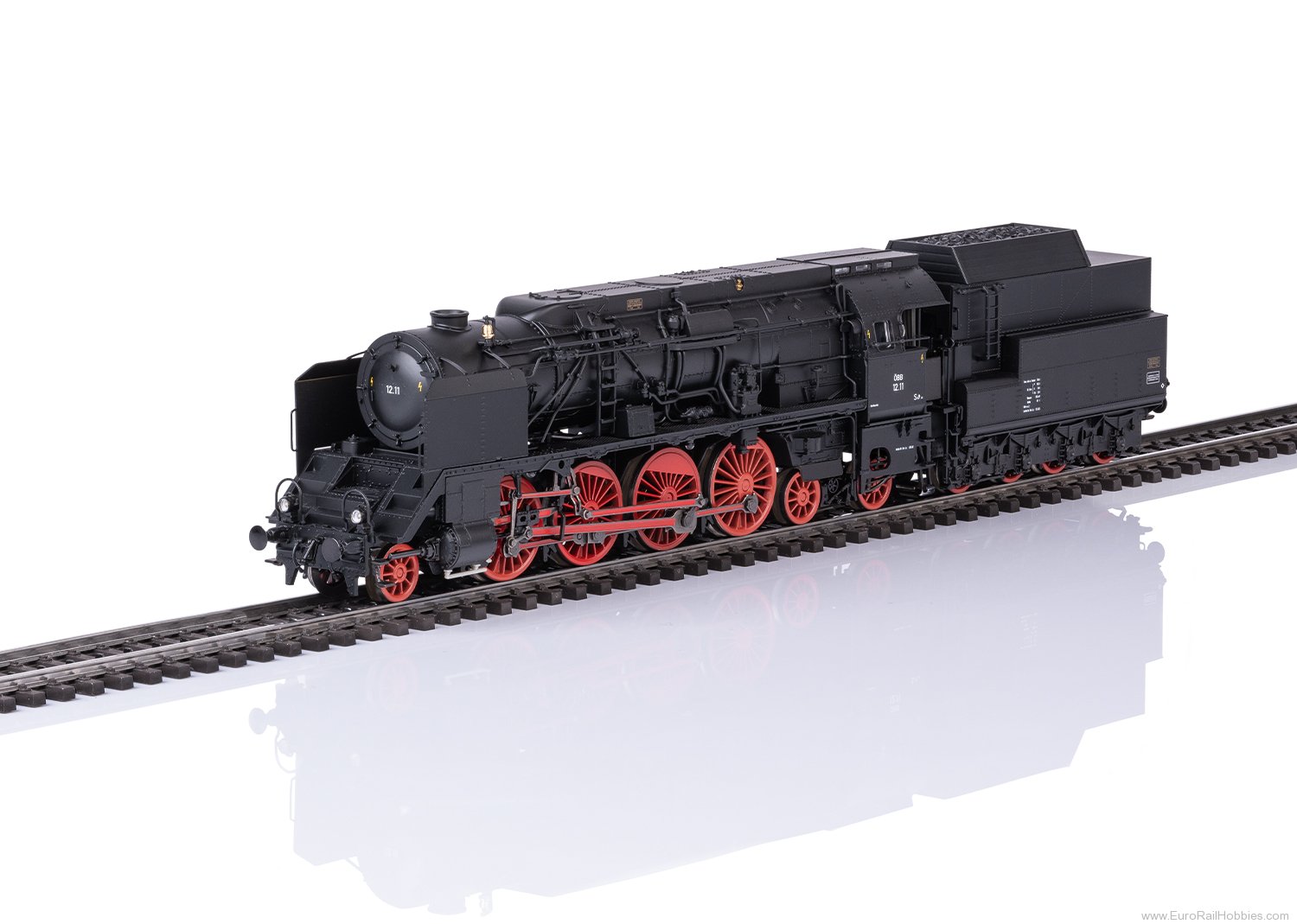

A record-breaking locomotive makes history
At the end of the Roaring Twenties, it was little Austria that caused a major sensation far beyond the borders of the Alpine republic by building a mighty express locomotive. The engineers had put an impressive Steam Locomotive on the tracks of the Westbahn (Western Railroad) main line between Vienna and Salzburg. With a gigantic boiler and four driving axles that sat nearly two meters / 6-1/2’ high, the new class 214 locomotives achieved a power output of nearly 3,000 hp. At the time, it was considered the most powerful express steam locomotive in Europe. In its home country, it also set a speed record of 156 km/h / 97 mph during test runs, and performed exceptionally well in scheduled service, even over long distances. Many German railroad workers looked on with a touch of envy at this Austrian Steam Locomotive, especially since it clearly outperformed the famous German class 01 loco. When the Western Railway from Vienna to Salzburg was fully electrified in 1952, the machines, then designated the class 12, lost their home route. Just ten years later, they were withdrawn from service. Märklin’s new Steam Locomotive, Road Number 12.11, now brings a miniature version of this icon of European locomotive engineering to the fascinating world of model railroads. Together with the two full-sized museum locos that have been preserved, it tells the story of an era when steam locomotives truly were engineering and visual masterpieces.
Prototype: Austrian Federal Railways (ÖBB) express train steam locomotive 12.11 with a tender. Version with dual front headlights, small DRG lanterns, large smoke deflectors, long dome streamlining, enclosed front section, and a series 9184 converted tender. The loco looks as it did in 1952.
Model: The loco has an mfx+ digital decoder and extensive sound functions. It also has a controlled high-performance motor with a flywheel, mounted in the boiler. One axle is powered, and three axles are driven by coupling rods. Traction tires are fitted. The locomotive and tender are constructed mostly of metal. The loco has a factory-fitted smoke generator with speed-dependent, dynamic smoke exhaust. Dual headlights change over with the direction of travel, will work in conventional operation and can be controlled digitally. Cab lighting and flickering from the firebox can be controlled separately in digital operation. The running gear lighting can be controlled digitally. Maintenance-free warm-white and red LEDs are used for the lighting. A buffer capacitor is fitted. There is a close coupling with a guide mechanism between the loco and tender. The tender has a close coupling with a guide mechanism and an NEM pocket. The buffer heights on the loco and tender conform to NEM specifications. The minimum radius for operation is 360 mm / 14-3/16". Protective piston sleeves and brake hoses are supplied.
Length over buffers approximately 25.4 cm / 10".
A matching passenger car set is available in the Märklin H0 range as item 42525. A DC version of this model is available in the Trix H0 range as item T25012.
Road number 12.11 – Former Queen of the Western Railway The setting is Austria in the aftermath of World War I. Slowly but surely, the battered country recovered, and the railroad played an important role in that process. This applied in particular to the Westbahn (Western Railroad) from Vienna to Salzburg, which, as the country’s most important main line, was to be electrified quickly. However, the Federal Railways (BBÖ) halted the project 1927, believing that the use of sufficiently powerful steam locos would make it possible to avoid the high cost of electrification. In 1927, the domestic locomotive factories in Floridsdorf and Wiener Neustadt were commissioned to develop prototypes that would be powerful enough to achieve the same journey times pulling heavy express trains on the Western Railroad as would have been possible with electric operation. Two versions of a powerful, eight-coupled express locomotive with the 2-8-4 wheel arrangement were built. In the end, the two-cylinder Floridsdorf version was selected over the three-cylinder loco from Wiener Neustadt. And it proved to be a masterpiece of engineering that boasted several outstanding features. With a power output of almost 3,000 hp, it was the most powerful express steam locomotive in Europe and the largest steam loco ever built in Austria. The gigantic, high-mounted boiler and the upwardly curved cab contributed to a fitting and extremely imposing overall appearance. In addition, the loco type designated as the class 214 boasted the world’s longest connecting rods, measuring 4.25 meters / 14'. During subsequent test runs, road number 214.13 achieved the highest speed ever recorded by an Austrian steam loco – 155 km/h / 96 mph. Due to the Great Depression, just 13 of these thoroughbred racers were produced between 1928 and 1936. Nevertheless, the electrification of the Western Railroad continued to stall, even though this propulsion type had long since been proven to be superior. Consequently, the class 214s continued to shine day in and day out, pulling heavy express trains at high speeds over long distances on their home route. Railroad workers soon bestowed the title “Queens of the Western Railroad” on these steam locomotives, which represented the state of the art at the time. This situation continued even during World War II when the German State Railroad was in charge. From 1938 onwards, the class 214 was given the designation 12, which was subsequently retained. After 1945, the ÖBB (formerly the BBÖ before 1938) turned its attention to the full electrification of its route network, with the Western Railroad, parts of which had already been completed, taking top priority. By the end of 1952, the catenary wire had reached Vienna, and on January 3, 1953, the last express train pulled by a class 12 loco departed from Vienna’s West Station. At that point, some of the “twelves” were transferred to the Southern Railway route to Graz. However, they had not been designed for the steep, winding route of the Semmering Railroad. As a result, their deployment there soon came to an end. By 1956, all 13 locomotives had been placed in storage in Vienna's boiler houses in the hope of finding a buyer for these powerful and relatively young locos. Unfortunately, by then, the future was deemed to belong to diesel and electric traction, and the retired “queens” were sent to the scrapyard in 1961/62. Only road number 12.10 was preserved at the Vienna Museum of Science & Technology. In 1985, the Austrian Society for Railway History (ÖGEG) purchased road number 142.063, which was originally built under license in Romania. Today, as road number 12.14, it also serves as a reminder of the time when steam locomotives still reigned supreme on Europe’s railroads.

Mon-Fri:


