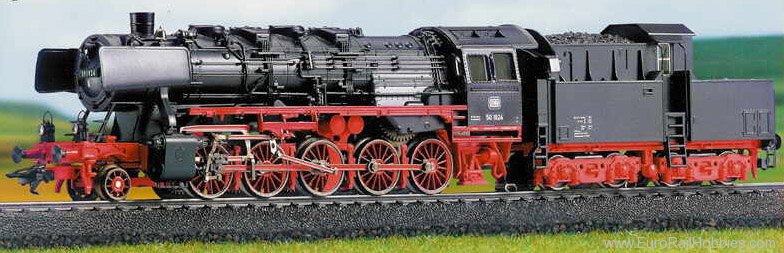
Prototype: German Federal Railroad (DB) BR 50.
Model: Comes with a digital decoder, controlled high-efficiency propulsion and
a TELEX coupler on the tender. The motor for the locomotive is in the boiler.
5 axles powered. 4 traction tires. Driving wheels divided into two linked groups
to enable the locomotive to negotiate sharp curves. Can be retrofitted with
a 7226 smoke generator. Headlights work conventionally in operation, but can
be controlled digitally. Smoke generator contact, TELEX coupler as well as acceleration
and braking delay can be turned on and off with the 6021 Control Unit. Adjustable
close coupling between the locomotive and the tender. Many separately applied
details.Length over buffers 26.3 cm / 10-3/8".
This is a Special Edition from EUROTRAIN & Idee & Spiel. Very limited! Reserve yours now!
Special articulated locomotive frame.
Motor and gear drive in the locomotive.
Digital: TELEX coupler for remote control uncoupling from the train.
Spacing between tender and locomotive adjustable.
With the conversion of the engine numbering system to the international
computer standard, the DB was faced with a special problem in 1968. The system
was designed for only 3 digits for the ordinal number after the 3 digits for
the class number, the latter including the"0" preceding the steam
locomotive class number. Of the original number of more than 3,000 units in
the class 50 more than 1,000 were still on the roster and scheduled for service.
The solution: in the future there were 4 classes for the original class 50
locomotives - 050 to 053 - the first digit of the ordinal number was transferred
into the class number, with the previous ordinal number remaing recognizable.
It must be mentioned here that the class 052 of Era IV had nothing to do with
the class 52 retired 5 years before this time.
Many of the "Computer class 50" locomotives were still in service
up to the end of the steam locomotive era in 1976. At the time they were not
even 40 years old, a service age that many active electric locomotives built
in the postwar period has already surpassed.