


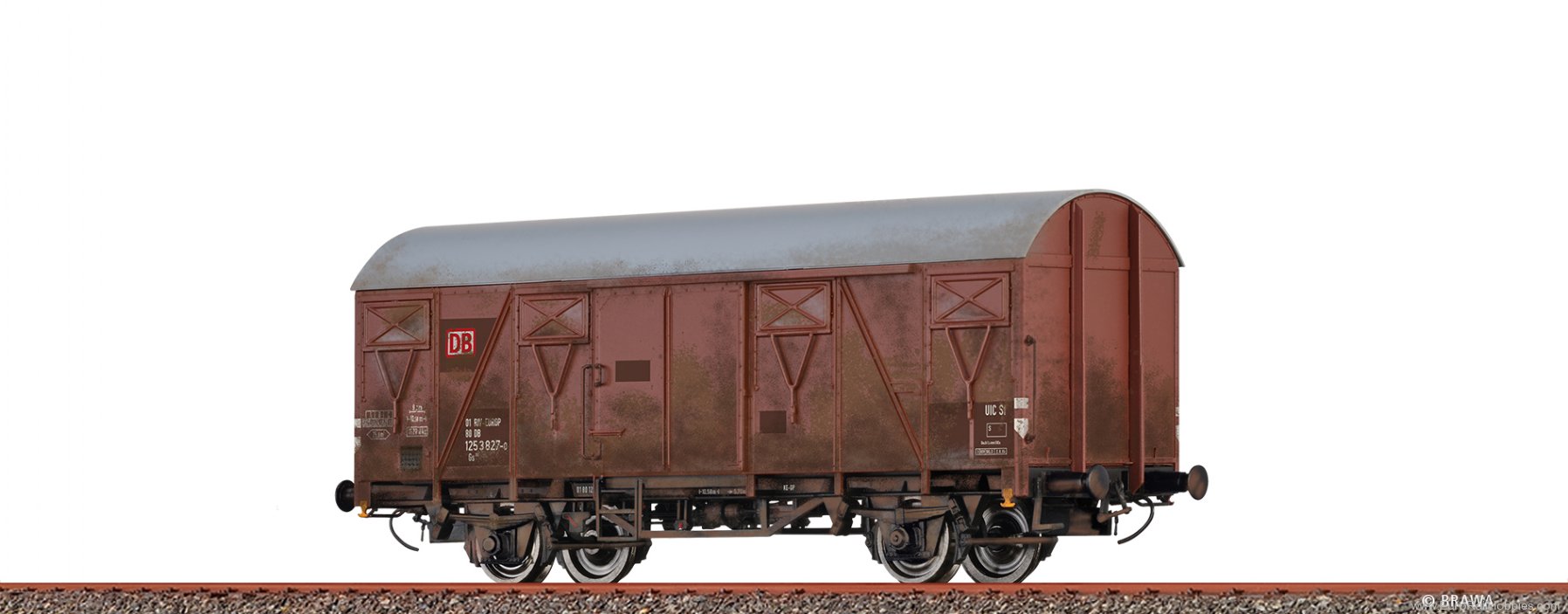
In 1949, the International Union of Railways (Union internationale des chemins de fer, UIC) founded its own Research and Development Institute (ORE), thus laying the foundation for internationally valid construction principles for freight wagons. On the basis of the ORE drafts and foundations for a two-axle standard freight wagon, the European railway administrations soon developed their own vehicles. In accordance with the basic idea of the UIC, these could be used to transport goods and commodities within the territories of the member administrations. The Deutsche Bundesbahn made a start with the first 3,500 wagons (according to the preliminary drafts) and was able to put the first 2,662 genuine UIC standard wagons into operation as early as 1957 with the Gmm(e)hs 56. Externally, the standardised design was identified by the address RIV St UIC. Other railway administrations such as the SNCF, FS, ÖBB, NS, DSB, MAV, P.K.P., CFL, SBB acted in a similar way and produced their own versions of the UIC standard wagons. Due to this circumstance, the cars are all very similar, but also have country-specific design differences. Since the DB itself had a very high demand for new wagons and there was also a modernization backlog for older wagon types, it was not only the complete new construction of UIC St wagons. In several conversion programmes, in which individual parts of older wagons were reused, the wagon types Gmms 44, Gmm(eh)s 60, Gmms 40 and 216 were gradually created. For the 1960s to 1990s, these wagon types were characteristic of freight transport in Europe and, with over 100,000 built, were included in almost every freight train.

Mon-Fri:


