


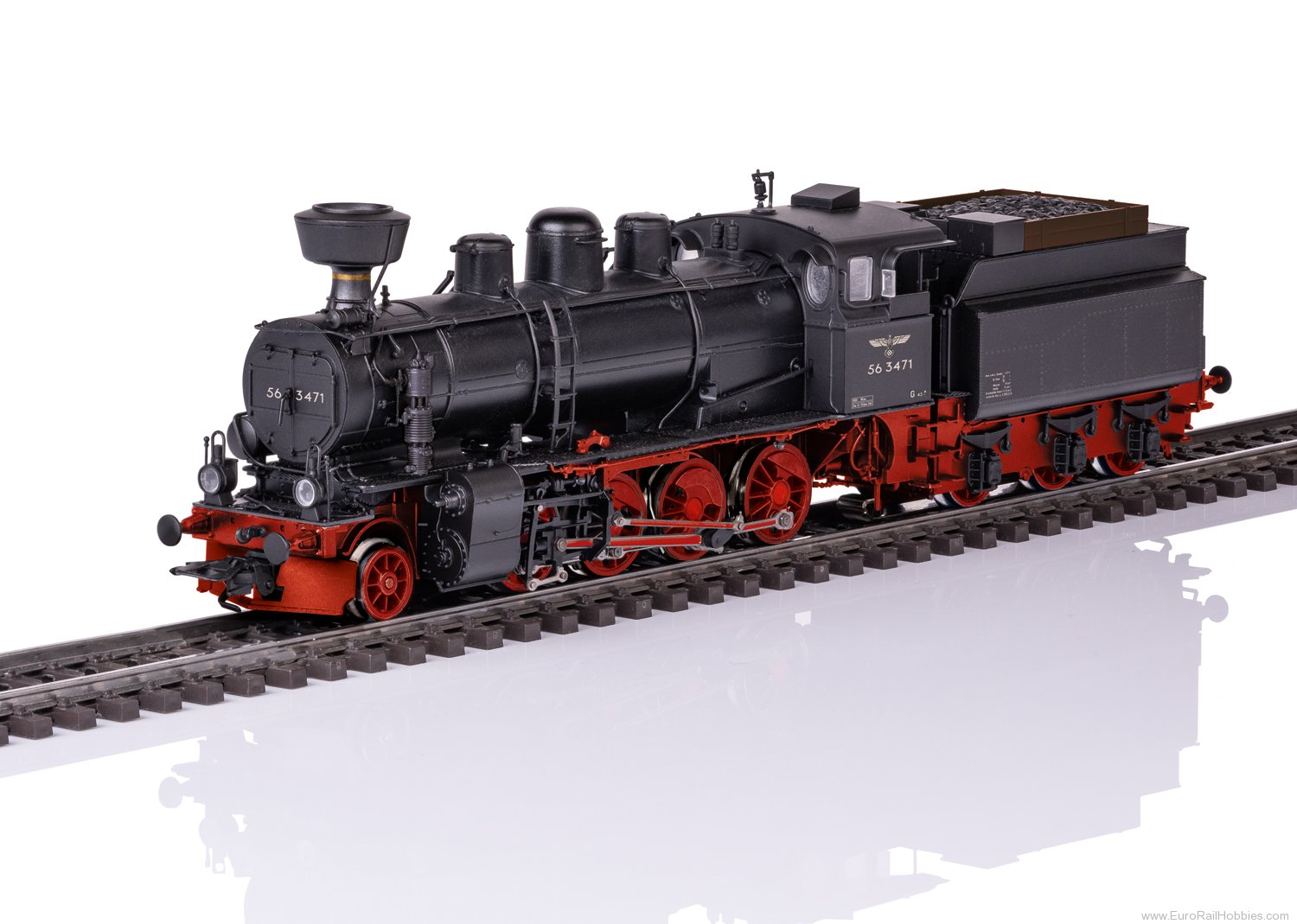

A revolutionary design: The first European loco In 1897, a brilliant young engineer designed a steam loco for the Habsburg Monarchy that went on to become one of the most important workhorses on the rails in many European countries. At the time, Karl Gölsdorf was the chief design engineer at the Vienna locomotive division of the Imperial Royal Austrian State Railways (kkStB). He was commissioned to design a modern and powerful general-purpose locomotive for the Arlberg Railway that would be capable of hauling even express trains along the mountainous route with its steep gradients and sharp curves. The result was the class 170, an eight-coupled tender locomotive with a leading axle, which entered service as the most powerful steam loco in continental Europe with an output of nearly 1,000 hp. The more modern superheated steam variant, the class 270, was developed by Gölsdorf's successor, Mr. Johann Rihosek and built from 1917 onwards. In the end, well over 1,000 units of both classes of this robust and reliable general-purpose locomotive were in service on the railroads of many Central, Southern, and Eastern European countries. Following the annexation of Austria in 1938, as many as 100 locos were added to the German National Railway fleet as the class 56.34-35. Even after 1945, this masterpiece of Austrian steam locomotive engineering continued to provide valuable service across many regions, and the last units only disappeared from scheduled services in the mid-1970s. As a finely detailed European steam loco in 1:87 scale, the new Märklin model now pays fitting tribute to this jack-of-all-trades that is so highly prized by railroad enthusiasts.
Prototype: German National Railway (DRB) class 56.34-35 freight steam locomotive with a tender, former class 270 of the Imperial Royal Austrian State Railways (kkStB) and the Austrian Federal Railways (BBÖ). The loco looks as it did after the BBÖ was incorporated into the German National Railway starting in 1938.
Model: The loco has an mfx+ digital decoder and extensive light and sound functions. It also has a controlled high-performance motor with a flywheel, mounted in the boiler. One axle is powered directly, and three axles are driven by coupling rods. Traction tires are fitted. The locomotive and tender are constructed mostly of metal. The loco has a factory-fitted smoke generator with speed-dependent, dynamic smoke exhaust. Dual headlights change over with the direction of travel, will work in conventional operation and can be controlled digitally. The cab lighting, firebox flickering, and running gear lights can be individually controlled in digital operation. Maintenance-free warm-white and red LEDs are used for the lighting. A buffer capacitor is fitted. There is a close coupler with a guide mechanism between the loco and tender. The buffer heights on the loco and tender conform to NEM specifications. The minimum radius for operation is 360 mm / 14-3/16". Protective piston sleeves and brake hoses are supplied. Length over the buffers approximately 20 cm / 7-7/8".
As a more powerful evolution of the widely used class 170 steam loco of the Imperial Royal Austrian State Railways, the class 270 superheated steam locomotive was introduced at the end of the First World War. The machines proved to be so capable that, after the war, additional orders were placed in Austria as well as in the states that succeeded the monarchy. The BBÖ ended up operating a total of 100 locomotives, which were then designated the class 56.34-35 following the annexation of Austria by Germany in 1938. During its service life with the DRB, the loco was used as a “jack-of-all-trades.”
A matching freight car set is also available in the Märklin H0 range as item 46570. This model has been developed in partnership with PIKO Spielwaren GmbH, Sonneberg, Germany.

Mon-Fri:


